This article contains affiliate links — we may earn a small commission at no extra cost to you.
Advertisement
The Booking Reality
Reservations for Zion National Park's main campgrounds open exactly six months in advance on Recreation.gov, and they sell out within minutes of release for peak season dates. For summer 2026 bookings, sites at Watchman Campground - the park's only reservation-only campground - typically vanish within 3-5 minutes of the 8:00 AM MT booking window opening. South Campground operates on a first-come, first-served basis and fills by 9:00 AM daily from March through October.
Advertisement
First-timers often don't grasp the intensity. A Friday night in June at Watchman draws over 2,000 people vying for roughly 190 reservable sites. The park's visitor guide puts it bluntly: book the instant your window opens or don't bother.
There are exactly three campgrounds inside Zion National Park proper - Watchman, South, and Lava Point - plus dispersed camping options in the surrounding national forest lands. Each serves a different camper and requires a different booking strategy.
Campground at a Glance
Campground
Total Sites
Site Types
Reservation vs Walk-in
Season Dates
Fee/Night
Elevation
Hookups
Watchman
190 (plus 3 group sites)
Tent, RV (up to 40ft), walk-in tent
Reservations only (6-month window)
Year-round
$20 base + $16 fee
3,900 ft
No hookups (electric on some sites)
South
117 (plus 2 group sites)
Tent, RV (up to 40ft)
First-come, first-served
March-October
$20 base + $16 fee
3,900 ft
No hookups
Lava Point
6 primitive sites
Tent only
First-come, first-served
May-October (weather dependent)
Free
7,890 ft
None
Photo: NPS via NPS.gov (Public Domain)
Watchman Campground: Complete Guide
Setting and Atmosphere
Watchman sits near the park's south entrance, just across the Virgin River from the town of Springdale. The campground runs along the river's edge, with cottonwood and box elder trees providing cover over most sites. You'll hear the river - a constant low rush that masks most road noise from the nearby entrance station.
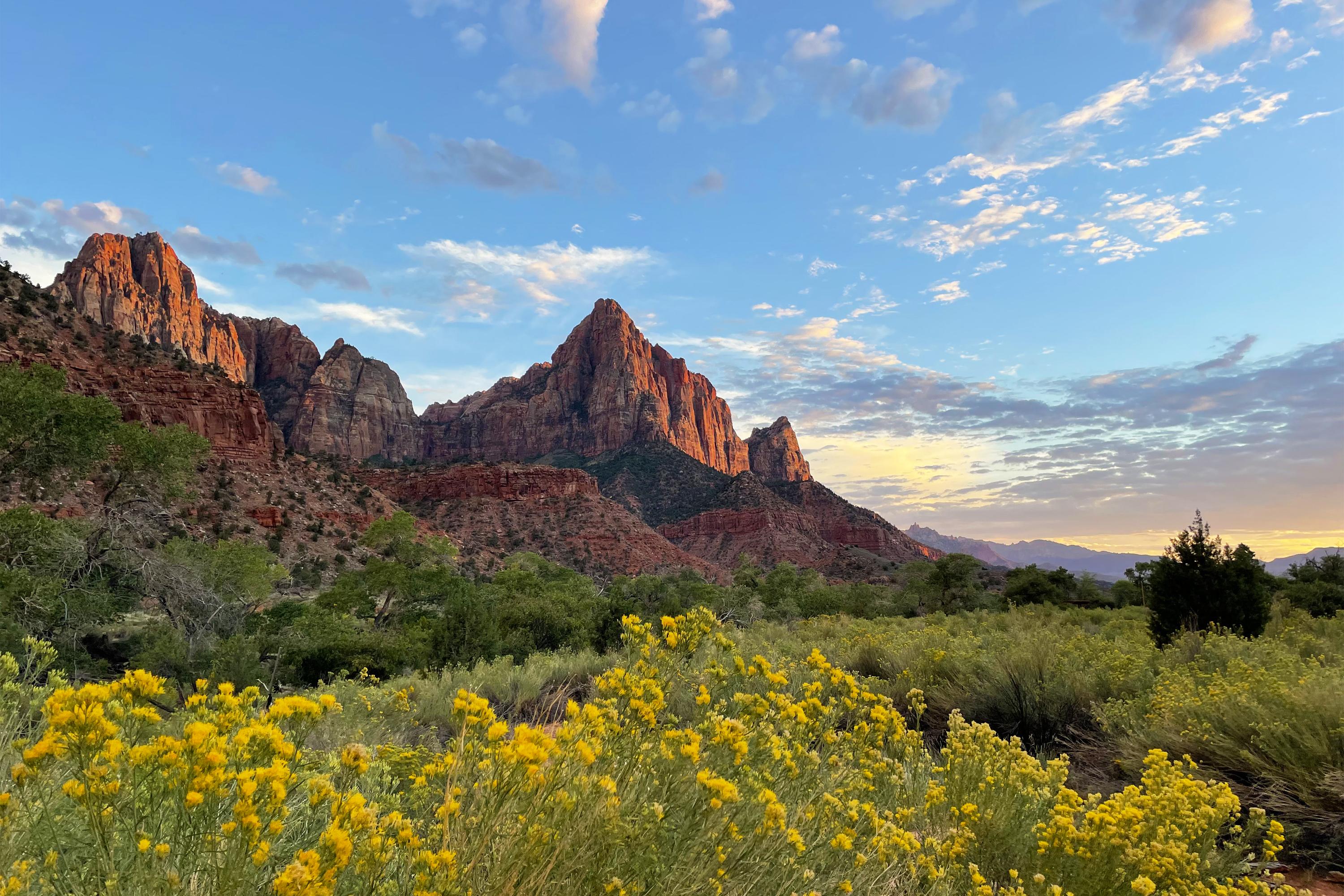
The terrain is flat gravel and packed dirt. Sites are arranged in loops off a single paved road. The name comes from the Watchman, a 6,500-foot sandstone peak that looms directly south of the campground. From the river-side sites, you get a direct view of the peak catching the last light of the day.
July afternoons are brutal. By late morning the gravel pads radiate heat, and by 2:00 PM the sun is overhead with no cloud cover. Cottonwood shade helps, but not enough for midday tent-sitting. Anyone who's spent a summer here rigs a secondary shade tarp over their tent.
Loop by Loop Breakdown
A Loop - The largest loop, with 95 sites. These are the most exposed, with smaller trees and less separation between neighbors. Sites along the outer edge (A01-A30) back up to the park road and get road noise from early morning traffic. Sites A31-A50 run along the river and are the best in this loop, with more vegetation and better privacy.
B Loop - 65 sites, generally considered the best loop. B sites have the largest cottonwoods, the most privacy between sites, and the easiest river access. B01-B20 are walk-in tent sites - you park in a central lot and carry gear 50-150 feet to a tent pad with no RV or vehicle noise nearby. B21-B50 are standard RV/tent sites with more space than A Loop.
C Loop - 30 sites, mostly RV-friendly with longer, straighter pull-throughs. Less shade than B Loop. Closest to the restrooms and dump station.
Specific Site Recommendations
Best for families: B06-B10 (walk-in tent sites with short carries, flat ground, and proximity to the river shallows where kids wade) or A40-A45 (standard sites near the playground and amphitheater).
Best for solitude: B01-B05 (walk-in sites at the far end, furthest from the main road, thickest vegetation between sites). Also B15-B20, which back up to undeveloped riverbank.
Best for RVs: C05-C15 (longest pull-throughs, easiest for rigs over 30 feet, minimal tree overhang). Site C12 is the flattest.
Sites to avoid: A01-A10 (closest to the entrance road, loudest, least shade). A85-A95 (near the dump station - the odor carries in still air).
Facilities Detail
Three restroom buildings with flush toilets and sinks. No showers. Potable water spigots are located at each restroom building and at a central fill station near the camp host site. The dump station is near the entrance to C Loop, open seasonally. There is no gray water dump at individual sites.
Rangers will tell you that the restrooms closest to the walk-in sites (near B Loop) are the least used and stay cleanest through the day. The restroom near A Loop entrance gets the highest traffic.
What the Booking Site Doesn't Show
The noise level varies dramatically by night. Weekends bring generators running past the 10:00 PM quiet hours in A Loop. B Loop walk-in sites have no generator noise because vehicles are parked separately. The river sounds louder at night in B Loop - some people find it soothing, others find it keeps them awake.
Cell service drops out at Watchman entirely on most carriers. Verizon gets a weak signal near the entrance station. T-Mobile and AT&T get nothing. The park WiFi at the visitor center is unreliable.
South Campground: Complete Guide
Setting and Atmosphere
South Campground is located a quarter-mile north of Watchman on the same road, closer to the Zion Canyon Visitor Center and the shuttle boarding area. The terrain is similar - flat gravel and dirt under cottonwood and box elder - but the vegetation is denser here. Sites feel more enclosed, with thick underbrush between most pads.
The trade-off is that South has no reservations and no guarantee. You drive in, hope for an open site, and if none are available, you drive back out to Springdale or the surrounding national forest.
Loop by Loop Breakdown
South has three loops - the Main Loop (65 sites), the Overflow Loop (40 sites), and the Group Sites area (12 sites for groups only).
Main Loop - The original campground, with the largest sites and best shade. Sites along the outer edge back up to the Virgin River. These river-side sites (S01-S20) are the most desirable in the entire park - more space, better views, and the sound of the river masks campground noise.
Overflow Loop - Added in the 1990s to handle demand. Sites are smaller, closer together, and have less shade. This loop fills last and empties first. If you arrive after 2:00 PM during peak season and get a site, it will almost certainly be in the Overflow Loop.
How the First-Come System Actually Works
The camp host begins assigning sites at 7:00 AM. Vehicles line up at the campground entrance starting around 5:30 AM during summer months. By 8:00 AM, the Main Loop is full. By 9:00 AM, the entire campground is full.
The common mistake - and almost everyone makes it - is arriving at 9:00 AM expecting to find a site. You won't. The line at the camp host station starts forming before sunrise. If you aren't in line by 6:00 AM during June, July, or August, plan to find other arrangements.
Site Recommendations
Best sites: S01-S15 (river side of Main Loop, thickest vegetation, most privacy). S05 is widely considered the best single site in the park - river access, full shade, and a view up-canyon.
Sites to avoid: Overflow Loop sites O25-O35 (directly adjacent to the road, no shade, dust from passing vehicles). Main Loop sites S50-S65 (near the restrooms and the camp host site, high foot traffic).
Facilities
Flush toilets and sinks at two restroom buildings. Potable water at both restroom locations. No showers. No dump station - you must use Watchman's dump station or the one in Springdale.
Photo: NPS via NPS.gov (Public Domain)
Lava Point Campground: Complete Guide
Setting and Atmosphere
Lava Point sits at 7,890 feet on the Kolob Terrace, roughly 25 miles from the main canyon. This is a completely different Zion - cool pine forest, no crowds, and temperatures 20-30 degrees cooler than the main canyon floor. In July, when Watchman hits 100°F, Lava Point stays in the high 70s.
The campground has six primitive sites with picnic tables and fire rings. Vault toilets only. No water - you must bring everything you need. The road to Lava Point is unpaved for the last 8 miles and can be rough after storms. Passenger cars can usually make it, but low-clearance vehicles should be cautious.
Who Should Stay Here
This campground is for people who want to escape the crowds and don't mind the drive. The Kolob Terrace offers excellent hiking with no shuttle requirements. The views from Lava Point overlook the entire Zion Canyon from a perspective most visitors never see.
The caveat: you are 45 minutes from the main canyon. If your plan involves the Zion Canyon Scenic Drive, Angels Landing, or the Narrows, you'll spend significant time driving. This is a basecamp for the Kolob area, not the main canyon.
Reservation Strategy
Watchman Campground
Reservations open at 8:00 AM MT exactly six months before your arrival date. For a July 15 stay, that means booking opens on January 15. The system uses Recreation.gov's rolling window - each day's reservations become available six months in advance.
The tactic that works: Don't search for specific sites. Search for "any available site" within the loop you want. Have your Recreation.gov account set up and payment information saved before the window opens. Be logged in at 7:55 AM and refresh exactly at 8:00.
Cancellation monitoring: People cancel Watchman reservations constantly. The best time to check for cancellations is between 6:00 PM and 10:00 PM MT, when the 48-hour cancellation penalty window approaches. Sites that were booked months ago pop up as people finalize their plans. Checking Recreation.gov's cancellation feed every few hours during the week before your trip can yield results.
South Campground
No strategy here beyond showing up early. The camp host starts assigning sites at 7:00 AM. Be in line by 6:00 AM during peak season. Midweek arrivals (Tuesday through Thursday) have better odds than weekends.
Group Sites
Both Watchman and South have group sites that can accommodate 7-12 people. These require a separate reservation on Recreation.gov and typically cost $30-$40 per night. Group sites at Watchman book even faster than individual sites - often within 60 seconds of the reservation window opening.
Photo: NPS via NPS.gov (Public Domain)
What to Know Before You Arrive
Bear Storage Requirements
Zion has black bears, though encounters are rare. All food, cooking equipment, and scented items must be stored in hard-sided vehicles or bear-proof lockers when not in use. Watchman and South both provide bear-proof food storage lockers at each site. Lava Point does not - you must bring your own or store food in your vehicle.
Rangers will tell you that the most common violation is leaving coolers on picnic tables overnight. This gets cited regularly.
Fire Restrictions
Fire restrictions are in effect throughout Zion National Park as of 2026. During summer months, this typically means no campfires outside of designated fire rings in developed campgrounds. During extreme dry conditions, all fires may be banned entirely. Check the park's fire restriction status online before your trip - it changes weekly based on conditions.
Propane stoves are generally allowed even during fire bans, but check the current restrictions.
Quiet Hours
Enforced from 10:00 PM to 6:00 AM. The camp hosts at Watchman are strict about this - generators off, voices down, doors closed quietly. South Campground enforcement is less consistent but still in effect. Violations can result in eviction.
Generator Hours
Generators are allowed from 8:00 AM to 10:00 AM and 4:00 PM to 8:00 PM. Outside those hours, generators must be off. B Loop walk-in sites at Watchman have no generator use at any time.
Water Situation
Potable water is available at Watchman and South at spigots throughout the campgrounds. Lava Point has no water. The Virgin River contains toxic cyanobacteria as of 2026 - do not submerge your head in or filter drinking water from the river or any streams in the park. Bring all drinking water with you or purchase it in Springdale.
Cell Service
Non-existent at Watchman and South. Verizon gets a weak signal near the entrance station. AT&T and T-Mobile get nothing. The visitor center has WiFi that works intermittently. Plan to be offline.
Checkout Time
11:00 AM at both Watchman and South. The camp host does rounds checking for late departures. Late checkout can result in a citation. For South Campground, leaving early means your site goes to someone in the waiting line - expect a knock on your tent if you're still there at 11:15.
Practical Takeaways
Book Watchman exactly six months in advance at 8:00 AM MT. Have your Recreation.gov account ready. The window opens and closes within minutes.
For South Campground, arrive by 6:00 AM or don't bother. The line forms before sunrise. If you arrive at 9:00 AM during summer, every site will be taken.
B Loop walk-in sites at Watchman are the best value. More privacy, no generator noise, and the shortest walk to the river. Reserve these specifically if you can.
Lava Point is free but requires preparation. No water, vault toilets, and a rough dirt road. Bring everything you need and don't expect services.
The Zion-Mt. Carmel Highway has vehicle restrictions starting June 7, 2026. Oversized vehicles over certain length, width, height, or weight limits cannot travel between Canyon Junction and the East Entrance. Check your rig against the posted limits before booking.
Park legally. Zion has limited parking and tickets vehicles parked outside designated stalls. Once the lots fill, park in Springdale and take the shuttle in.
Bring a secondary shade tarp. The cottonwood shade helps, but by mid-afternoon in July, your tent will be an oven without additional cover.
No showers at any campground. The nearest public showers are in Springdale at the Zion Canyon Campground (fee for non-guests). Plan accordingly for multi-day stays.
Download maps and information before you arrive. There is no cell service and the visitor center WiFi is unreliable. Recreation.gov works offline if you download your reservation in advance.
Check fire restrictions the day before you arrive. Conditions change rapidly and the park updates restrictions weekly. A campfire ban during your stay changes your meal planning significantly.